


Clinics, practices & medical groups
Medical staff scheduling software for clinics and practices
Snap Schedule is medical staff scheduling software: it schedules your people. Medical assistants, front desk, nurses, techs, billers, and providers, across every office you run. It does not book patient appointments and it is not a practice management system. If you already have an EHR and still build the staff schedule in a spreadsheet, this is the piece that is missing.

What this actually is
Staff scheduling and patient scheduling are two different products
Search for medical scheduling software and almost everything you find is patient-facing: online booking, reminders, waitlists, no-show reduction. Those tools schedule appointments. Snap Schedule schedules people, which is the problem your practice manager is solving at seven in the morning when two medical assistants call out.
Most practices need both, and they are rarely the same vendor. Your EHR or practice management system owns the appointment book. Snap Schedule owns the staff roster, the coverage, the time off, the callouts, and the hours that go to payroll.
We are saying this plainly because the category name is genuinely confusing and buying the wrong thing wastes a quarter.
Snap Schedule does this
- Builds the staff work schedule by position, skill and site
- Tracks who is authorized to work at which office
- Shows required versus assigned headcount per shift
- Fills call-offs and open shifts without a phone tree
- Handles time-off requests, accruals and shift trades
- Tracks license and certification expiry dates
- Records punches and exports hours to payroll
Snap Schedule does not do this
- Book or manage patient appointments
- Store charts, notes or any clinical record
- Verify insurance eligibility or file claims
- Replace your EHR or practice management system
- Provide contract or agency staff to fill your gaps
- Serve as a HIPAA-compliant system of record
- Run provider call panels as a standard configuration
The problem, specifically
Three moments a spreadsheet cannot survive
Two call-offs before the doors open
One MA is sick, one has a childcare problem. The practice manager starts texting people individually, from memory, hoping to reach someone who is qualified, off today, and not already at 38 hours. Rooms open in fifty-six minutes.
The float is booked in two places
Your cross-trained MA is on the North office schedule and the Westside schedule for the same afternoon, because those are separate tabs maintained by separate people. Nobody finds out until patients are already waiting at one of them.
A card expired in March
Someone’s BLS certification or state license lapsed months ago and they have been on the schedule the whole time. There was no reminder because the renewal dates live in a binder, or in a column nobody sorts.
These are ordinary, not exceptional. In its May 2026 poll of 303 medical practice leaders, MGMA found turnover has stabilized rather than resolved, with 28% of groups still reporting higher turnover than the prior year and the churn concentrated in exactly these roles: medical assistants, front desk and patient access, and clinical support. A schedule built on institutional memory breaks every time one of those people leaves.
More than one office
Clinic staff scheduling across every office you run
Every shift belongs to a location, and every person is authorized only for the sites they can actually work. This is the part that separates a clinic group from a single-site business, and it is where general-purpose shift apps start to leak. In Snap Schedule, a location is a real object: a work site where a shift is performed. Every shift is assigned to one. You then authorize each employee for the locations they are cleared to work.
If someone gets scheduled at a site they are not authorized for, the software tells you at the moment of assignment rather than on the morning of. And because location is a first-class field, you can filter any of the eight schedule views down to one office, or open all of them side by side and see the whole group at once.
- Unlimited locations on a single subscription, with no per-site fee
- An alert when an employee is scheduled somewhere they are not authorized to work
- One roster across the group, so a float assigned at North is visibly unavailable at Westside
- Location filters on every schedule view, plus location breakdowns in reports
- Recurring rotation patterns for people who work a fixed site-by-day cycle
The double-booking problem, stated plainly
A cross-trained assistant cannot be double-booked across two offices when both offices draw from the same roster. Separate spreadsheets per site make that failure structurally possible. One schedule makes it structurally impossible.
Travel time is still yours to manage
Snap Schedule will stop you assigning someone to overlapping shifts and to sites they are not cleared for. It does not calculate drive time between your offices or build travel buffers automatically. If your North and Westside locations are forty minutes apart, you build that gap into the shift definitions yourself.
Coverage
Staffing gaps become visible while you can still fix them
The Shift Coverage Planner shows the number of employees scheduled for each shift broken out by position, by skill, or by assignment reason, next to the headcount you required. Snap Schedule computes the variance and color-codes it, so an understaffed clinic day reads at a glance instead of being discovered on the morning.
That distinction matters more in a practice than in most businesses, because your roles are not interchangeable. Three people on the floor is not coverage if none of them can room a patient or none of them can work the front desk.
What it answers
Do I have the physicians, nurses, medical assistants and front desk I need on each shift, at each site, and if not, how short am I?
What it does not answer
Whether your required numbers are right. Those come from your own visit volume and staffing model. The software compares assigned against required and shows the variance. It does not forecast demand from appointment data, because it never sees your appointment data.

Scroll the schedule sideways to see every crew and its coverage.
Required, assigned and variance by position, per shift. The negative numbers on registered nurses and front desk are the gaps you want to find on Monday rather than on the day.
The same structure drives the reports, which is where healthcare staff scheduling earns its keep at budget time. Snap Schedule ships more than 60 built-in reports covering assignments, coverage, labor cost, overtime, time off and punch activity, each filterable by location, position and skill, and exportable to PDF, Excel or CSV.
Licenses and certifications
Renewal dates that chase you, instead of the other way round
Record it once, on the person
Skills and certifications attach to the employee record, each with an expiry or renewal date. State licenses, BLS and ACLS, CMA and RMA credentials, radiography permits, dental x-ray certification, immunization competencies, whatever your state and specialty require.
Get warned before it lapses
Snap Schedule raises an alert on the Scheduler Dashboard when a credential is inside the warning window you set, or has already expired. You choose how many days of runway you want.
Pull the list for an audit
The Employee Skill and Certification Expiration report returns everyone whose credentials fall inside a date range you specify, so a credentialing review is a report run rather than an afternoon with a filing cabinet.
Because skills are a scheduling field and not just an HR record, they also filter who is eligible for a shift. A shift that requires a credential will not surface staff who do not hold it.
Call-offs and open shifts
Two ways to fill a gap without working down a phone list
If you schedule in a spreadsheet today, filling a hole is a manual process: you work out who is qualified, you check who is already working, you guess who is near overtime, and then you start texting people one at a time and keeping score in your head. Snap Schedule has two purpose-built ways to do that, and they suit different situations.
Open shift bidding, when you have notice
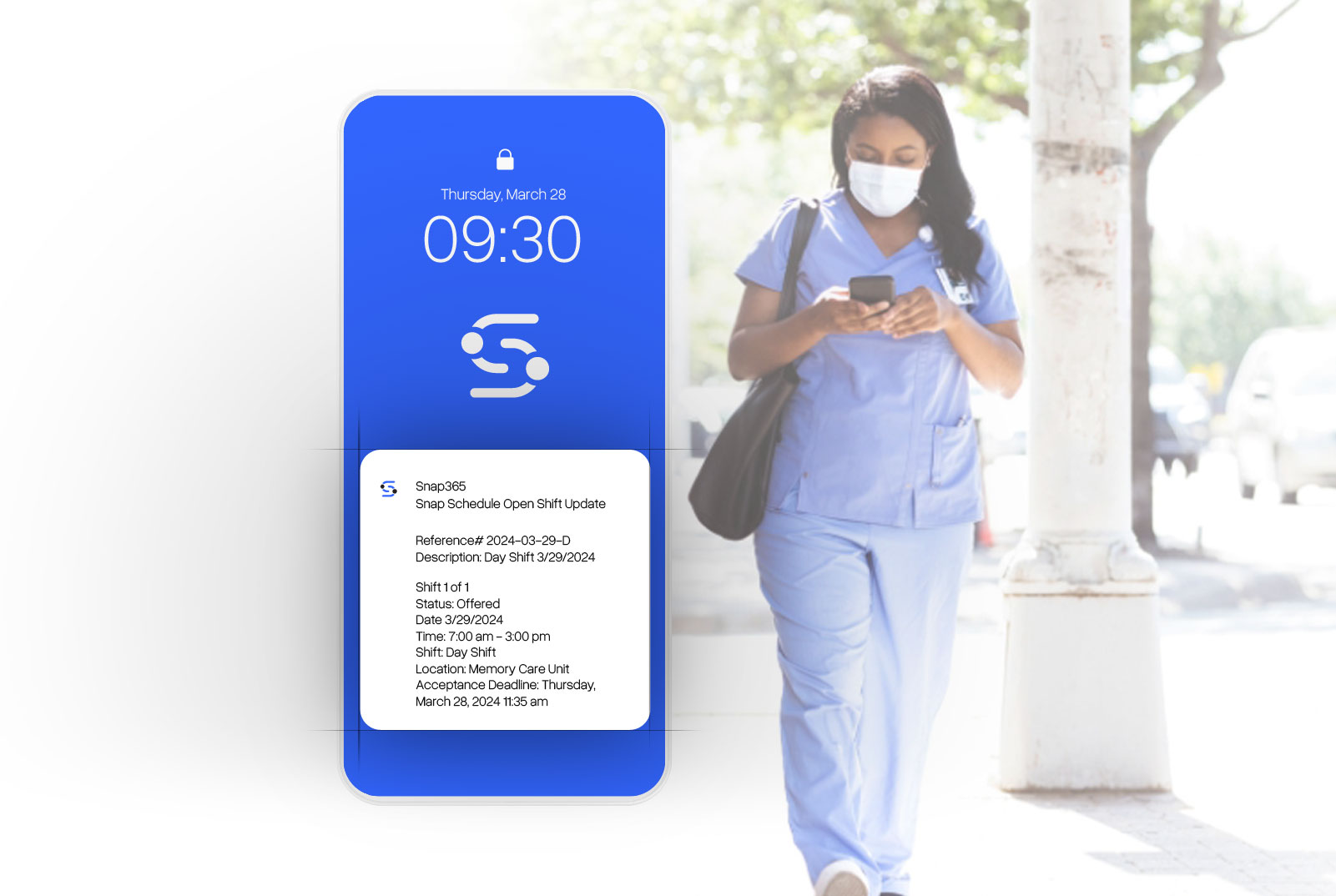
You post the uncovered shift. Snap Schedule works out who is eligible for it and invites all of them at the same time. Staff see the offer on their phone and bid on the shifts they want. You either award it yourself or let the software award it automatically against the criteria you set. Nobody is phoned, nobody is chased, and the people who want extra hours get a fair look at every shift instead of only the ones you happened to think of them for.
Automated callout, when someone rings in sick at 6 a.m.
This one works through the list for you, one person at a time. Snap Schedule contacts the first eligible candidate, waits the response window you set, and if they decline or the window expires it moves to the next automatically. It does that at six in the morning whether or not anyone is awake to run it, and it keeps going until the shift is covered or the list is exhausted.
Both reach people by SMS, in-app notification or voice call. Both filter to eligible staff before the first message goes out. Both log every contact, every response and every timestamp, so when someone says they were never asked, there is a record rather than an argument.
What “eligible” checks
Position and skill, whether the person is available, whether they already have a conflicting assignment, whether the shift keeps them inside their daily and work-period hour limits, and whether they are authorized to work at that location. Staff who fail any of those never get the offer.
One difference worth knowing
Bidding contacts everyone at once. Callout contacts people one at a time, in order. If you need a shift covered in the next twenty minutes, bidding gets more eyes on it faster. If you need people worked through in a set order, callout is the right tool. If you have an overtime distribution or seniority order that has to be enforced by the software, tell us early and we will scope it properly rather than pretend it is a checkbox.
Finds the gap for you
Coverage shortfalls are detected against your required headcount rather than reported by whoever happened to notice.
Only contacts eligible people
No more calling someone who is already on shift, out on leave, or not cleared to work at that office.
Acceptance becomes the assignment
When someone accepts, the shift is assigned and the schedule updates. No re-keying, no second version of the truth.
What staff see
The schedule stops living in one person’s head
With the Employee Access add-on, staff get their schedule on their phone and can do the things that otherwise land in the practice manager’s inbox: request time off, check accrued balances, pick up open shifts, propose a trade, update availability, punch in and out, and review their time card before it goes to payroll.
The practical effect for a practice with no HR department is that the scheduling conversation moves out of group texts and into a record. When someone says they never got the change, there is an answer.
What the practice manager stops doing
Re-sending the schedule after every change. Fielding “am I on Thursday” by text. Keeping a running tally of who is owed hours. Retyping punches into payroll.
What you still decide
Whether trades need approval, who can be invited into a trade, how far ahead staff can see the schedule, and whether punches are restricted by geofence or by IP address.

Fit
Where this healthcare staff scheduling software fits
Primary care and specialty groups
Two to twenty sites, shared MAs and front desk, one person building the schedule.
Urgent care and extended hours
Evenings, weekends and rotating cover, with shift premium policies for the differentials.
Dental groups
Hygienists and assistants rotating between offices, with credential dates tracked per person.
Imaging and diagnostics
Modality-specific credentials as scheduling criteria, so only certified techs surface for a shift.
Behavioral health
Mixed licensed and unlicensed staff across sites, with position-level coverage requirements.
Billing, RCM and back office
Non-clinical teams on shift coverage, including hybrid and remote schedules.
Payer and health services operations
Member services and clinical call queues staffed against required coverage by hour.
Home health and DME
Field staff punching in with GPS against assigned shifts and locations.
Constraints
What Snap Schedule will not do for a medical practice
It will not talk to your EHR out of the box
There is an API and there is CSV export for payroll systems including ADP, Workday and SAP. There is no pre-built connector to Epic, athenahealth, eClinicalWorks, NextGen, Dentrix or any other clinical system. Anything in that direction is an integration project with its own scope and cost.
It will not schedule providers by call rules as standard
Physician call panels with equalization, post-call rules and swap markets are the domain of dedicated provider-scheduling products. Snap Schedule handles provider shifts as shifts. If your call rules are elaborate, buy a tool built for them.
Employee phone access is licensed separately
A scheduler license covers building and publishing the schedule for an unlimited number of employees. Staff self-service on the app is a separate add-on. Worth raising early, because most practices decide they want it.
It will not supply you with staff
Some scheduling vendors in healthcare also operate a labor marketplace and place agency workers into your open shifts. We do not, and we have no financial interest in your open shifts staying open. Snap Schedule is software you license and nothing else.
It will not tell you your staffing model is wrong
Required headcount, staff-to-provider ratios and skill mix are inputs you supply. The software enforces and reports against them. It has no opinion about whether they are right for your visit volume.
It will not rank callout candidates by overtime or seniority
Worth repeating because competitors imply otherwise. Standard rules handle eligibility. Ordering logic, overtime equalization and rotation lists are custom work BMS builds and quotes as a separate engineering engagement.
Product tour
Watch a staff schedule go from blank week to published
Build the week, assign by position and site, catch the conflicts as you create them, then publish it to everyone at once. If your schedule currently lives in a spreadsheet, this is the fastest way to see what actually changes.

Watch for three things in particular: how a shift is placed on a person directly rather than typed into a cell, how a double-booking or a missing credential is flagged at the moment of assignment instead of after publishing, and how an uncovered shift goes out to eligible staff and comes back as an accepted assignment.
Most of what you will see takes a practice manager an afternoon to get comfortable with, not a training program.
Questions
Frequently asked questions
Is Snap Schedule patient appointment scheduling software?
No. Snap Schedule is employee scheduling software. It builds and manages the work schedule for your staff: who works, in which role, at which location, on which day. It does not book patient appointments, hold a patient calendar, send appointment reminders, or manage a waitlist. Practices normally run Snap Schedule alongside an EHR or practice management system that owns the appointment book.
Does Snap Schedule work for a medical practice with multiple locations?
Yes, and it is the main reason multi-site practices choose it. You can define an unlimited number of locations on one subscription with no per-site fee. Every shift is assigned to a location, and each employee is authorized for the specific locations they are cleared to work. Snap Schedule alerts you if someone is scheduled at a site they are not authorized for, and every schedule view can be filtered to one office or opened across the whole group. Because all sites share one roster, a person assigned at one location is visibly unavailable at the others.
Is Snap Schedule HIPAA compliant?
No, and we want to be unambiguous about that rather than let you find out later. The Services are designed for ordinary workforce scheduling information and are not offered or intended as a system of record for HIPAA-related data. Business Management Systems does not act as a business associate under HIPAA, and the Services are not offered as a HIPAA-compliant system of record.
In practice this is a fit question rather than an obstacle for most practices, because a staff roster is not patient information. Snap Schedule holds employee data: names, positions, skills and certifications, work locations, scheduled and worked hours, time-off records and punch activity. There is no field in the product intended to hold protected health information. What that does require is a small discipline on your side: shift assignment notes are a free-form text field, so instruct your schedulers never to type patient identifiers into them. If your evaluation requires a signed Business Associate Agreement from every vendor regardless of what data they hold, Snap Schedule will not clear that bar, and you should know it before you invest time in a trial.
Can Snap Schedule track medical assistant, nurse and technician certification expiry?
Yes. Skills and certifications are recorded on the employee record with expiration or renewal dates, covering state licenses, BLS and ACLS cards, CMA and RMA credentials, radiography permits, dental x-ray certification and anything else you define. Snap Schedule displays an alert on the Scheduler Dashboard when a credential falls inside the warning window you set or has already expired, and the Employee Skill and Certification Expiration report lists everyone whose dates fall in a range you specify. Because skills are a scheduling field, they also restrict which staff are eligible for shifts that require a given credential.
How does Snap Schedule handle staff who float between offices?
Cross-trained staff are authorized for each location they can cover, and are scheduled from a single roster shared by every site. That structure prevents the failure mode most multi-site practices know well, where separate spreadsheets per office both claim the same person for the same afternoon. Snap Schedule does not calculate drive time between your sites or insert travel buffers automatically, so if two offices are forty minutes apart you build that gap into the shift definitions yourself.
Can staff see their schedules and request time off from their phones?
Yes, with the Employee Access add-on, which is licensed separately from the scheduler subscription. Staff can view their schedule, request time off and see accrued balances, pick up open shifts, propose or accept trades, update availability, punch in and out, and review their time card. You control which of these are enabled, whether trades need manager approval, and whether punches are restricted by geofence or IP address.
Does Snap Schedule integrate with our EHR or practice management system?
Not with a pre-built connector. Snap Schedule has an API and exports payroll-ready data in CSV for systems including ADP, Workday and SAP. There is no packaged integration with Epic, athenahealth, eClinicalWorks, NextGen, Dentrix or other clinical systems, and building one would be a scoped project rather than a configuration setting. In practice most clinics run the two systems side by side, because the appointment book and the staff roster are managed by different people for different reasons.
How does filling an open shift or a call-off work?
There are two mechanisms. Shift Bidding posts the open shift to all eligible employees at once and collects bids, which suits shifts you know about in advance. Automated Callout works through candidates sequentially: it contacts one person, waits the response window you configured, then advances automatically if they decline or do not answer. Both reach staff by SMS, in-app notification or voice call (email is not a callout channel), filter candidates by position, skill, availability, hour limits and location authorization, and log every contact and response. Callout does not contact multiple people simultaneously; that is what Shift Bidding is for.
Can Snap Schedule order callouts by overtime hours or seniority?
Not as a standard setting. The built-in employee selection rules govern eligibility only: availability, conflicting assignments, daily hour limits, work-period limits, home location and location authorization. Ordering candidates by accumulated overtime, breaking ties on seniority, charging declines, rotating a list, or escalating from voluntary to mandatory are all custom rules that BMS engineers build for a specific customer. That work is quoted separately from the subscription and priced as an engineering engagement, so if your practice has an overtime distribution policy that has to be enforced by the software, raise it early and we will scope it honestly rather than implying it is a checkbox.
How does Snap Schedule help control overtime and labor cost?
Overtime settings and hourly rates are defined per employee and per work period, and the schedule is costed as you build it. The Estimated Labor Cost reports break out regular hours, overtime hours, shift premium cost, on-call cost and payable time off, by employee and by period, filterable by location. Shift premium policies handle evening, weekend and holiday differentials. Because callout eligibility checks daily and work-period hour limits, the system will not offer a shift to someone the offer would push into overtime, unless you have configured it to allow that.
How is Snap Schedule licensed?
On an annual subscription with two components. You license schedulers, meaning the people who actually build and change schedules and approve requests, and each scheduler license covers an unlimited number of employees across an unlimited number of locations. If you want your staff to have the app for schedules, time off, trades and punching in, that is a separate per-employee add-on. Most practices need only one or two scheduler licenses regardless of how many sites they run, because the constraint is how many people build schedules, not how many people are on them. Volume discounts apply at higher scheduler and employee counts, and current figures are published on the Snap Schedule 365 pricing page.
We build our schedule in Excel today. What actually changes?
Three things, mostly. First, the schedule stops being a document you distribute and becomes a system people look at, so a change you make at 9 a.m. is a change everyone sees at 9 a.m. rather than a new version of the file. Second, the rules move out of your head and into the software: it knows who is qualified, who is already booked, who is off, who is near an overtime threshold, and it tells you at the moment you create a conflict instead of after you publish. Third, filling gaps stops being a manual phone or text exercise. What does not change is that you still decide the staffing model, the required headcount and the patterns. The software enforces your decisions rather than making them.
Can we import our existing spreadsheet?
Your employee, shift and task data can be imported from Excel, so you are not retyping a roster to get started. What does not import cleanly is a spreadsheet’s layout, because a schedule grid in Excel is a picture of assignments rather than structured data. In practice the setup work is defining your shifts, positions, skills and locations once, then building assignments on top of that. It is the same information you already hold, expressed in a way the software can reason about.
How long does it take to get running?
That depends almost entirely on how complicated your own rules are, so treat anyone who quotes you a fixed number without asking questions with suspicion. A single-site practice with a handful of positions and a stable weekly pattern is a short exercise. A group with several sites, cross-trained float staff, differentials and accrual policies takes longer, mostly in defining those policies precisely rather than in software configuration. The honest way to find out is to walk a real week of your coverage through a demo and see how much of it is standard setup.
What happens when the person who builds the schedule is on vacation?
This is one of the better reasons to move off a spreadsheet. When the schedule lives in one person’s file and one person’s memory, their absence is an operational risk. In Snap Schedule the roster, the patterns, the rules, the time-off balances and the assignment history are all in the system, so somebody else can cover with far less handover. You can license a second scheduler for a backup, and you can restrict what that person is allowed to change.
Do all our staff have to use the app?
No. The scheduler side works on its own: you can build the schedule, print it, publish it as a PDF, or email it to staff with an iCalendar attachment they can load into their own calendar. The employee app is optional and adds self-service, which is where most of the administrative time savings come from. Some practices start scheduler-only to get the roster under control and add employee access later once the schedule is stable.
Go deeper
The capabilities behind this page
See it against your own schedule
Bring a week of your real coverage and we will walk through how it would be built in Snap Schedule, where the standard system handles it, and where it would not. If you would rather poke at it yourself first, the trial runs thirty days and needs no card.
Or call our sales team on 1-800-450-4230, Monday to Friday, 9am to 5pm Pacific.